
What it is
Our temperature gauges include bimetal dial thermometers and capillary-type thermometers for remote reading. They are fitted with a stem that goes into the process, usually inside a thermowell.
We also supply thermowells to suit.
How it works
In a bimetal gauge, a coiled strip of two metals bends as the temperature changes, and the bend turns the pointer. In a capillary type, the sensing bulb is connected to the dial by a thin tube, so the dial can be mounted away from the hot point.
Where it is used
- Pipes, tanks and heat exchangers
- Boilers and heating systems
- Machines and ovens
- Places where the dial must be read from a distance (capillary type)
Things to consider
- Choose the stem length (U) so the sensing part sits in the flow.
- Use a thermowell so the gauge can be changed without stopping the process.
- Check the working range and the mounting direction.
What to tell us for a quote
- Temperature range
- Dial size and stem length (U)
- Connection and thread size
- Need for a thermowell
- The medium and its working pressure
- Quantity
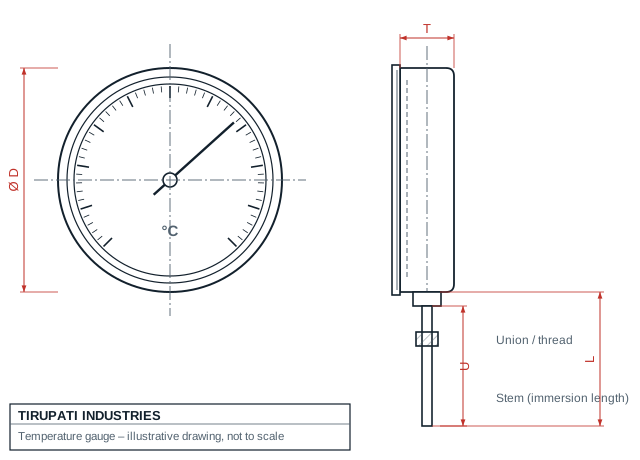
Questions about temperature gauges
Why use a thermowell?
A thermowell protects the stem from pressure, flow and corrosion, and allows the thermometer to be removed and replaced without opening the process.
Need temperature gauges?
Send us the range, medium and connection and we will quote.